Posts

Showing posts with the label chain drive

Retensioning

Image
Medium speed four stroke engines and small two stroke engines use a simple method of checking and adjusting chain tension. The tension is checked by turning the engine so that the longest side of the chain is the slack side. (this is usually when the engine is running astern). After stopping the engine, the chain is then pulled back and forward by hand, and the transverse movement should be between ½ and 1 link. Adjustment is carried out by tightening or slackening the adjustment nuts on the tensioner; see diagram. On larger engines, the method described above becomes increasingly difficult to carry out, so the tension is adjusted automatically by using the compression of a spring to give the correct chain tension. This negates the need for measuring the play in the longest side of the chain when slack (½ - 1 link). The engine is continuously turned in the ahead direction (so that the longest side of the chain is tight). The nuts are slackened off...
Renewing the chain

Image
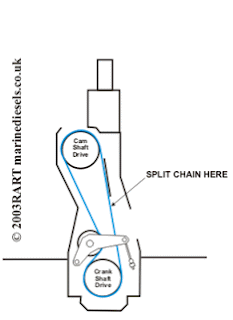
The camshaft chains will have to be replaced when their elongation reaches 1% or after 15 years. The reason for placing a limit on it’s elongation is that as the chain gets longer the pitch increases and is not matched to the wheel teeth, and continued use would result in excessive wear. The chains are replaced one at a time. This is so that the connected chain can be used to turn the engine whilst the new chain is pulled round. To change a chain on a large 2 stroke engine, the chain is slackened off at the tensioner. The top chain case cover is removed, and one of the chains is split at the point indicated. see here on how to split the chain. The new chain is attached to the old chain with a temporary link, and as the engine is turned, the old chain is pulled out of the engine, the new chain is fed in. Once the new chain has been joined, the process is repeated for the second chain and the chain retensioned. The...

chain elongation

Image
Students sometimes have difficulty in visualising the effects of the elongation of a timing chain on the timing of the camshaft. This model may help in understanding what happens. It should be made clear from the start that timing chains do NOT stretch, The factor of safety is too high. However, they wear on the bushings and rollers, and this causes elongation and thus a change in the pitch of the chain. For the model, I used bicycle parts, two large wheels of 42 teeth and a smaller 21 tooth wheel for the jockey on the tensioner. Two chains were used; a brand new chain with a pitch of 0.5 inch (12.7mm) and an old worn chain. The percentage elongation between old and new chains is about 2.5% which is way above the max allowable on an actual engine of 1%, but because my model is not to scale, will show the effects more clearly. It will be noticed that a series of 29 links have been painted red and white on both chains. This is to highlight the difference in length and also t...